


TELECOM COMPLIANCE & FILING
Prepare, review and track supported telecom filings with control.
ZoikoTax connects governed regulatory obligations to supported return and filing workflows — bringing preparation, validation, review, approval, submission tracking and evidence into one controlled path.ZoikoTax is designed to connect governed regulatory obligations to supported return and filing workflows — bringing preparation, validation, review, approval, submission tracking and evidence into one controlled operating path.
Keep the reason for the filing, the data used, the approvals given and the submission outcome connected instead of reconstructing them later.
* Capability coverage varies strictly by active country and regulatory packs. Autonomous approval or direct fund movement is out of scope.
Direct Answer
What is ZoikoTax Compliance & Filing?
ZoikoTax Compliance & Filing is a dedicated workflow layer for preparing, validating, reviewing, approving, and tracking telecom returns and regulatory filings. By grounding every filing in its originating regulatory obligation, the platform preserves the context of approvals, versions, notices, and durable evidence.
What the platform supports
- Inheriting obligations and rules per country pack
- Structured workpapers and validation checks
- Preparer, reviewer, and approver segregation
- Submission and receipt tracking where supported
- Notices, rejections, and amendment lineages
- Immutable evidence trails for historical replay

What remains out of scope
- Claims of universal country or channel coverage
- Autonomous AI signature, filing, or approval
- Direct electronic submission in unsupported zones
- Filing execution without prior customer sign-off
- Fiduciary fund custody, payment, or escrow
- Substituting for professional legal or tax advice



Operational Complexity
Why telecom compliance is structurally hardWhy telecom compliance and filing is structurally hard
Nine failure vectors that require strict systems discipline over loose manual tools.

Multiple Obligations
Divergent tax, USF, and carrier-specific regulatory duties across tiered local jurisdictions.
Data Readiness Gap
Reconciling CDR volumes, transactions, and bundles into return-ready aggregates with clear provenance.
Review Authority
Lack of clear separation between preparer, checker, and final approver leads to audit exposure.
Channel Variation
Submitting via mail, secure portals, batch uploads, or APIs depending on local capability limits.
Ack Uncertainty
A submission is not an acceptance. Managing silent failures or pending statuses is error-prone.
Amendment Lineage
Reconstructing past states when retroactively correcting a prior period without breaking current logic.
Regulatory Change
Keeping schemas, tax thresholds, rates, and forms up to date across shifting global rulesets.
Evidence Retention
Losing validation logs, input artifacts, and receipts when personnel rotates or legacy systems deprecate.
Coverage Variability
Managing international operating models where support status ranges from validated to suspended.
State Transitions
The controlled filing lifecycle
Every filing moves through governed, visible states — ensuring exceptions remain exposed rather than hidden.
Inherit
obligation active
Prepare
draft workpaper
Validate
rules check
Review
checks complete
Approve
governed sign-off
Submit
supported channel
Track
ack/receipt pending
Correct
amendment loop
- STAGE 01
Inherit
obligation active
- STAGE 02
Prepare
draft workpaper
- STAGE 03
Validate
rules check
- STAGE 04
Review
checks complete
- STAGE 05
Approve
governed sign-off
- STAGE 06
Submit
supported channel
- STAGE 07
Track
ack/receipt pending
- STAGE 08
Correct
amendment loop
Product Proof
Representative system interfaces
Explore three critical frames demonstrating how the system monitors work, stores evidence, and tracks the lifecycle. All details are Representative and Illustrative of system capabilities.

Filing Registry / Workspace
⚠️ System Notice: 2 filings require manual review. Submissions cannot occur until governed approvals are recorded.
USF Form 499-Q
Not submitted- Authority
- Federal (F1-US)
- Period / Due
- Feb 2026 (2026-03-01)
- Readiness
- Ready for review
- Owner / Channel
- Alex T. via Supported API
View Details →
E911 Surcharge Return
Not ready- Authority
- State (S1-US-CA)
- Period / Due
- Q1 2026 (2026-04-30)
- Readiness
- Draft workpaper
- Owner / Channel
- Sarah K. via Manual upload
View Details →
Telecom Excise Tax
Submitted- Authority
- Local (L1-US-SAC)
- Period / Due
- Q1 2026 (2026-04-30)
- Readiness
- Approved
- Owner / Channel
- Alex T. via Supported API
View Details →
Utility User Surcharge
Status unavailable- Authority
- Local (L1-US-OAK)
- Period / Due
- Q1 2026 (2026-04-30)
- Readiness
- Not applicable
- Owner / Channel
- System via External
View Details →
State Gross Receipts
Rejected- Authority
- State (S1-US-NY)
- Period / Due
- Q1 2026 (2026-04-30)
- Readiness
- Exception raised
- Owner / Channel
- Sarah K. via Manual upload
View Details →
Filing Detail & Evidence AuditFiling Detail & Evidence Audit Panel
EVIDENCE SEALED01 IDENTITY & OBLIGATION
Filing Return: USF Form 499-Q (Q1 2026)
Originated from: Active obligation F1-USF-2026Originated from: Active obligation F1-USF-2026
02 PREPARATION DETAILS
Reported amount: [Illustrative reported amount A]
Workpaper Hash: sha256_9c23b8f2d57b... (passed)Workpaper Hash: sha256_9c23b8f2d57b... (deterministic validation passed)
03 REVIEWS & APPROVALS
Preparer: Sarah K. (2026-02-15)
Approver: Alex T. (2026-02-18 sign-off)Approver: Alex T. (2026-02-18 governed approval sign-off)
04 SUBMISSION VERIFICATION
Filing outcome: Acknowledged by authority gateway
Receipt Hash: sha256_evidence_seal_88e31a...Receipt Hash: sha256_evidence_seal_88e31a...
Preparation & Workpaper Model
All source data undergoes strict validation. Calculations must be deterministic, preventing silent adjustment by black-box algorithms.
Draft
Schedules initialized with CDR aggregates
Needs Data
Awaiting manual adjustment or batch upload
Validation Check
Running validation check against ruleset
Ready for Approval
Approved as recommended by system check
Segregation of Duties & Governed Roles
Explicit permission boundary parameters prevent unauthorized actions. There is no single universal role model.
Preparer
Edit draft, compile workpapers, upload attachments
Reviewer
Validate outputs, raise exceptions, check variances
Approver
Finalize filing state, authorize submission queue
Viewer/Auditor
Read-only access, run historical replay, export evidence
Submission State & Receipt Tracking
Explicit states differentiate a submitted file from an accepted file. Duplicate-safety loops prevent accidental duplicate submissions.
- Ready to Submit
- Submitting
- Submitted
- Acknowledged
- Accepted
Notices, Rejections & Amendments
When an authority notice is received or a filing is rejected, the amendment lineage preserves historical submissions instead of overwriting them. No legal penalties or consequences are inferred.
Authority Notice
Awaiting reviewNotice ingested, linked to origin filing period
Rejected Filing
Needs amendmentException exposed, state changed, original data frozen
Amendment Lineage
TraceableRe-run calculations, submit replacement, bind to previous transaction ID

Obligations Interlock
No orphan filing tasks
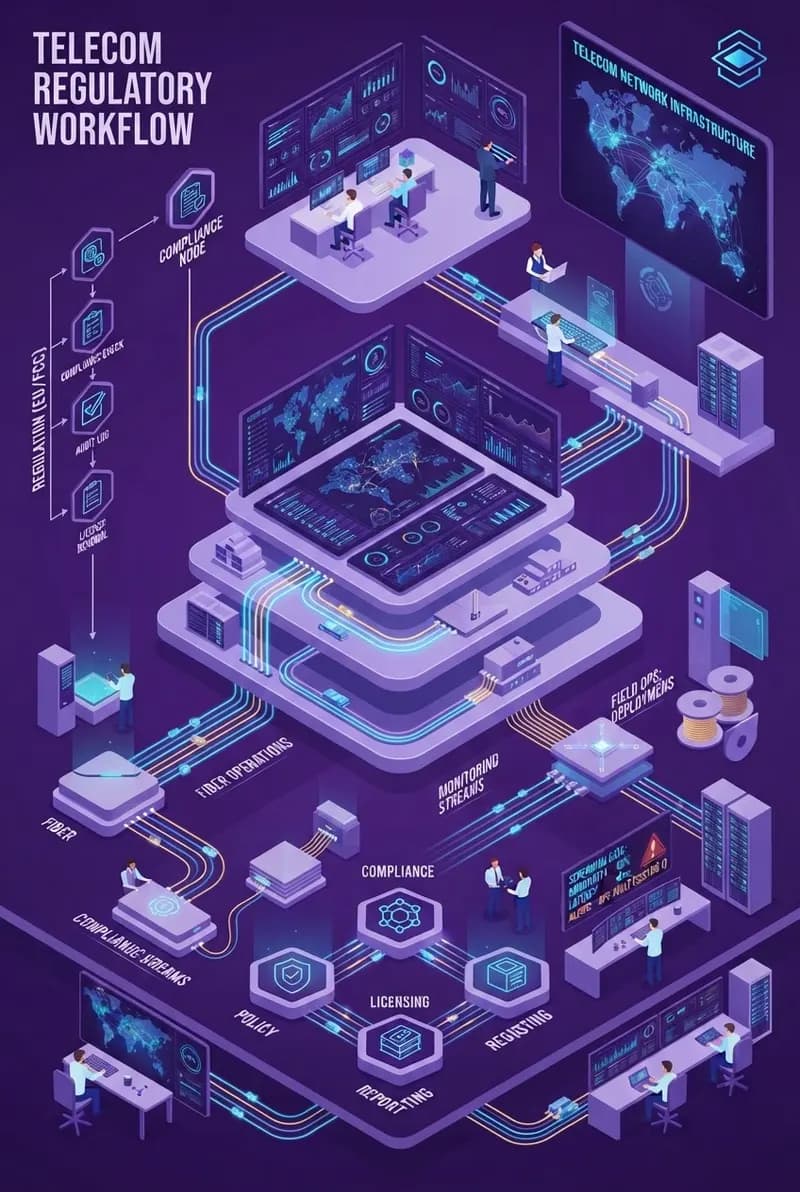
Every filing in ZoikoTax must interlock directly with an upstream registration, active obligation, or country pack regulatory timeline. Filing tasks are never floating checklists.
Traceable Flow StepsTraceable Flow
1. Active country pack defines the required registration.
2. Obligation manager tracks due dates and rules.
3. Filing registry pulls obligation specs directly into draft.
1. Active country pack defines the required registration. 2. Obligation manager tracks due dates and rules. 3. Filing registry pulls obligation specs directly into draft.
Configure & Track Obligations
Explore Regulatory ObligationsSystem Boundaries
Filing versus RemittanceFiling versus Remittance Orchestration
ZoikoTax maintains a strict boundary between reporting a filing return and moving actual tax funds.
Compliance & Filing
Tracks form validation, approvals, preparation logs, notices, and receipt statuses. Focuses on governed workflows and immutable evidence trails.
Remittance Orchestration
Generates remittance payment instructions and approval flows for treasury teams. System Limitation: ZoikoTax does not custody, execute, or hold payment funds.
System Boundaries
Filing versus E-Invoicing & CTC
Understand how periodic reporting is distinct from continuous transaction clearance networks.
Compliance Return FilingCompliance Return Filing
Aggregates historical data to compile periodic returns (monthly, quarterly, or annually) for submission to local tax and regulatory authorities.
E-Invoicing & Continuous ClearanceE-Invoicing & Continuous Clearance (CTC)
Real-time invoice clearance, digital invoice reporting, and strict network validation per transaction. Clearance receipts are distinct from filing receipts.


Traceability System
Evidence, auditability & historical replayEvidence, auditability and historical replay
Compliance is not defined by a simple green Filed badge. You must be able to reconstruct the historical decision chain years later.
Historical Decision Chain Archive
- Originating obligation ID reference & active rule versions
- Filing inputs, CDR workpaper states, and calculation outputs
- Internal checks: validation outputs, threshold alerts
- Approver, Preparer, and Reviewer cryptographic timestamps
- Authority receipts, acknowledgements, notices, and amendments

Reconstruct Decision Trails
Explore Evidence & ReplayOperating Architecture
Flexible operating models & coexistence
Fit your current billing, BSS, or tax engine architecture.
Native stack
End-to-end determination and filing tracking managed through active ZoikoTax country packs.
Federated mode
Integrate with legacy tax engines. ZoikoTax handles obligation tracking and workpaper validation.
Shadow assurance
Compare calculations, detect variances, and validate readiness before cutting over production paths.

Global Coverage
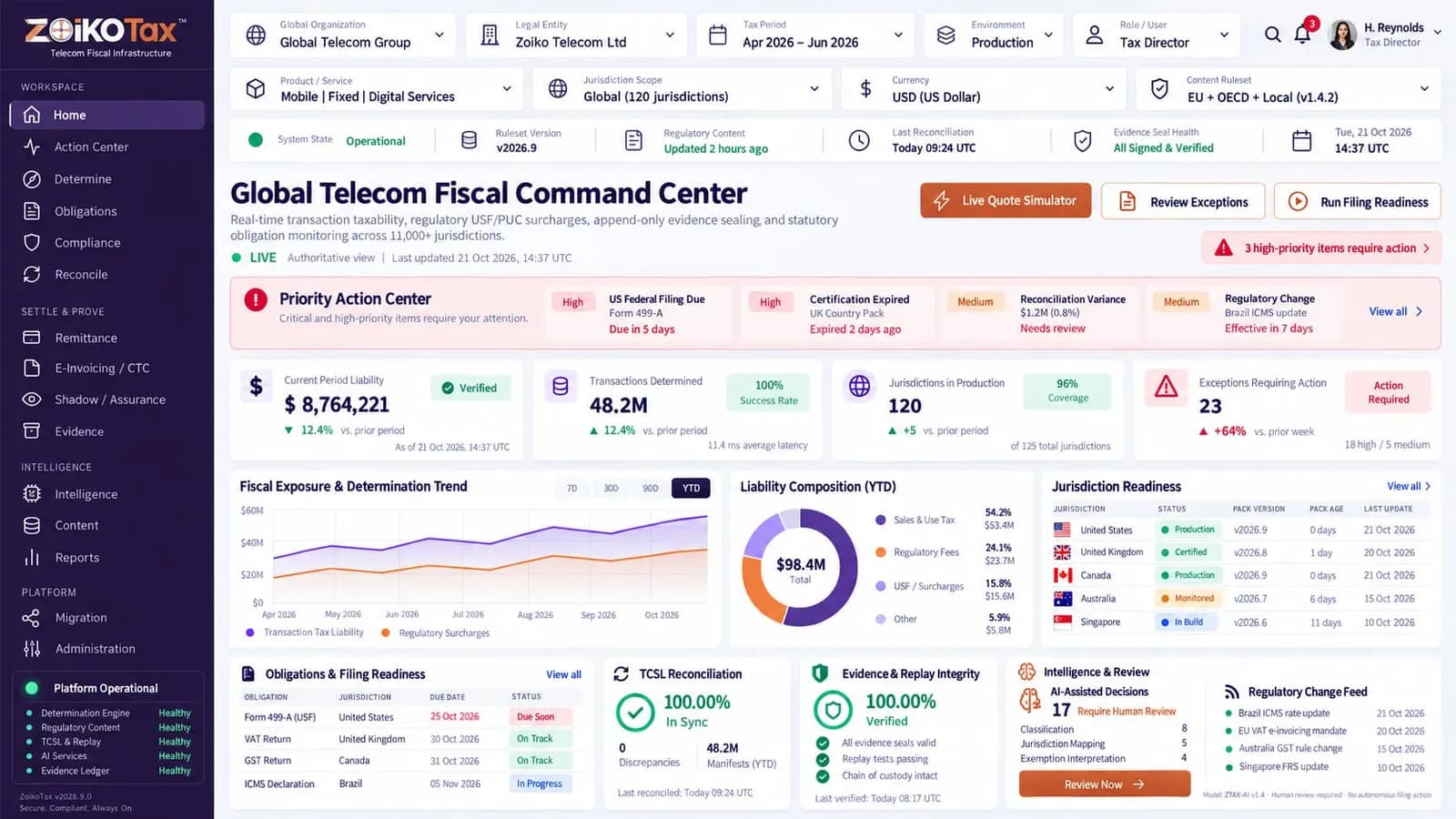
Availability transparency — no inflated mapsAvailability transparency — no inflated coverage maps
Filing formats and requirements vary globally. We clearly label active capabilities so teams can integrate with confidence.
Readiness Classifications
Market Pack Status Preview
Governed Automation
AI assists. Approved rules decide.AI assists. Approved rules decide. Evidence proves.
Our advisory artificial intelligence features assist your operations without overriding human governance.
AI Features May
- Summarize notice text or flag authority rejections
- Detect anomalies, variance trends, or missing fields
- Suggest transaction classification classifications
- Organize and rank items in preparation queues
AI Features May Not
- Autonomous sign off, approve, or submit returns
- Alter rules, schemas, or active due dates silently
- Bypass required preparer or reviewer approvals
- Act as professional tax, legal, or accounting advice


Operational Security
Control is an architectural property
ZoikoTax uses a strictly governed, residency-aware infrastructure to isolate sensitive data and isolate tenant contexts.
Tenant Isolation
Logical separation isolates operations between customer units.
Credential Protection
Secure authority credentials are held under strict access parameters.
Residency-Aware
Locality constraints determine where server-side data is persisted.
Value & Governance
Engineered for teams accountable for outcomes
Bring structural control, historic validation, and auditable proof back into your compliance lifecycle.
Durable Audits
Reconstruct exactly what was reported, what rules generated the calculations, and who approved it.
Expose Exceptions
Rather than silently smoothing over rejections or missing contexts, errors stay highly visible until resolved.
Change Aware
Keeps systems aligned with changing global forms, country pack requirements, and schemas.
FAQ
Direct answers. No inflated claims.
- What does ZoikoTax Compliance & Filing do?
- It provides a managed workflow system to validate raw tax data, structure return papers, assign preparer-reviewer-approver permissions, track supported submission paths, and preserve compliance receipts.
- Does it file every telecom return in every country?
- No. Capability coverage is limited strictly to active country and regulatory packs. Some jurisdictions require manual uploads rather than direct electronic connections.
- How does it relate to Regulatory Obligations?
- They are directly interlocked. Filing tasks are generated from active registration obligations, preventing orphan tasks or missing filings.
- Does submitted mean accepted?
- No. A submission only verifies receipt of data by the gateway. Acceptance is a separate, downstream authority decision. ZoikoTax isolates these states.
- Can it handle amendments?
- Yes. Amendments are generated from original logs. The system preserves the historical return data rather than overwriting past results, maintaining a complete lineage.
- Does it move payment after filing?
- No. Filing reporting is structurally separated from treasury orchestration. ZoikoTax generates payment instructions but does not hold, move, or custody fiduciary funds.
- How does AI work?
- AI features operate purely as an advisory assistance layer (anomaly flags, notice summary extraction, category suggestions). Determinations require human sign-off against rules.
- Can filing history be reproduced later?
- Yes. ZoikoTax seals the origin data, calculation formulas, active rulesets, and approval logs, allowing teams to replay and reconstruct the filing years later.



CONTROL THE FILING LIFECYCLE
See how ZoikoTax can connect obligations, filing workflows and evidence in your telecom operation.
Evaluate a governed path from filing readiness and review through supported submission tracking, exception handling and historical proof — without assuming every jurisdiction works the same way.